

Category: Uncategorized
My 12 Favorite Pieces I’ve Sang… Ever… So Far
I’ve done a lot of talking about choral music on this blog, there’s no doubt about that. I’ve told you about pieces my choir has done and pieces I love to listen to. Now, I want to make a sort of Top Twelve List of my favorite pieces I’ve sang throughout my high school career. These pieces have shaped my love of music, they’ve stuck with me for years, and I’ll never forget them. And yes, 12 is a weird number, but there were some I just couldn’t decide on. Anyway, without further ado, in no particular or chronological order, here are my 12 favorite choral pieces I’ve sang in high school.
1. Northern Lights – Ola Gjeilo
This piece was one of the first pieces I sang in my freshman year of high school. To me, this song is a somber admiration of the beauty of our world, specifically, well, the Northern Lights. The tense and gorgeous harmonies that Gjeilo create seem to mirror the pulsating and twisting forms that the wondrous lights in the sky create. When we sang this, we pulled down the screen in the auditorium and dimmed all the lights. We projected images of the Northern Lights onto the screen, bathing the audience and the edges of the choir in faint green light as the harmonies soared in the background. This piece was and still is magical, and it was a great introduction to the choral world.
2. Desh – Ethan Sperry
This song is a fun and fast (at times) Indian raga. The beginning starts off in a slow, 7/8 flow with the tenors whispering “Thom ta taka dimi thom ta taka juna.” Soon, the women come on a gentle line singing “mola” which means sleep in Hindi. The rest of the syllables in this song, like the tenor line above, are complete nonsense and gibberish. As we approach the quicker part of the songs, these syllables become more frequent, and eventually, the choir breaks into a fast 4 with syllables and sounds firing from all directions. These gibberish syllables are attempting to recreate the sounds of Indian instruments using only the human voice. This song is a fun combination of calm and fast all in one, and I will always remember this one.
3. For the Fallen – Eleanor Daley
I sang this song at the ILMEA District 3 Festival my sophomore year. This piece was one of the first I’ve sang that deals with the struggles of war. There is something special about music in the context of war to me, maybe because no matter how this world is divided, human emotion and pain can be conveyed BY all people TO all people through music. Anyway, this piece is a memorial to the brave soldiers that fought and died in World War I, but the song can be used to honor any who have fallen in battle. The first line really sums up why I love this song: “There is music in the midst of desolation.” This song is full of tragedy and beauty, and it is an honor to sing it.
4. Twinkle, Twinkle, Little Star – Daniel Elder
Yes, you read that right. It is Twinkle Twinkle Little Star, like the kids nursery rhyme. This piece was a part of our Madrigal Dinner this year. When this piece was presented to my chamber choir this year, we were very curious as to why this was on our repertoire. This song, however, not only proved to be beautiful, but also to be one of the most challenging pieces we sang in terms or breathing and vocal control. This piece is a very interesting take on the classic melody that almost everyone knows, with with beautiful, transcendental melodies that flow along like the sea under and ever changing night sky.
5. The Awakening – Joseph M. Martin
The Awakening was and still is one of my favorites for its message, passion, and shift from somber to triumphant. The beginning describes a dream where music is no more. The men and women take turns passing of flowing lines that describe such a world, while in the mean time, the piano plays haunting and melancholy melodies. Then, when this section ends, the piano begins to pick up, and the singers begin echoing over and over “awake.” The piece ends with a full chord, proclaiming “let music live.”
6. Faure’s Requiem – Gabriel Faure
This particular requiem was performed by the OHS choir my sophomore year. Rather than a single piece, this masterwork is made up seven separate movements. A requiem itself is a work that asks for rest and tranquility for the dead. Each movement in this work is very unique and presents a different themes of death, such as mourning, anger, pleading, and eventual acceptance. Each movement has complex melodies and harmonies, and each one is haunting and beautiful in its own way.
7. Earth Song – Frank Ticheli
This song was performed by the Olympia Chamber Choir in my junior year. This is another song that recognizes the power of music. It too utilizes somber melodies and themes, with music acting as a beacon of hope near the end. The ending of the piece arrives after singing about strife and grief in the first half. The choir flows to the end, and on the last chord, the piece resolves to a major chord as the voices softly sing “peace.” I adore this peace. In fact, I love it so much that a line from it is my senior quote: “But music and singing have been my refuge, and music and singing shall be my light.”
8. Miniyama Nayo – Paul John Rudoi
This was another piece sang by both my choir and the District 3 Honors Choir during my junior year. This piece is the definition of musical insanity. Wondering what language it’s in? Take a guess. I’m no psychic, but I know whatever guess you made is wrong, because the text of this song is complete gibberish. The lines are made up mainly of steady sixteenth note runs, with some eventual complex offbeat back and forth lines. It’s fast, intense, and fun. This is a piece I would highly recommend singing.
9. Underneath the Stars – Kate Rusby, arr. Jim Clements
(Note: the video above is sung in a different key than the key we sang it. Don’t worry, it’s still just as gorgeous). This piece was another tune featured at the Madrigal Dinner 2018. It featured my good friend, a mezzo soprano with a gorgeous voice, on the solo near the end. It gave every single person in that gym chills. To be honest, I’m not exactly sure what it is about this song that makes me love it so dang much. Maybe it’s the harmonies that clash and collide in some spots, and divide and lock in others. Maybe it’s the lyrics that have an almost angsty feel. Whatever it is, it’s beautiful, and I hope you think so, too.
10. I Will – arr. Jeremy Fox
Now, I’m throwing some jazz into the mix! I sang this song in the 2019 ILMEA Honors Vocal Jazz Ensemble, and it was so relaxing and gorgeous. The song features a female soloist as the other lines ooh and ah flowing, complex harmonies. This arrangement has so much love in the music and such a gentle nature in its performance. I had the privilege to work on this song with Dr. Jeremy Fox himself. He was mild mannered yet passionate, and his mentoring in the jazz realm is something I will never forget.

11. The Seal Lullaby – Eric Whitacre
Alright, so admittedly, I haven’t sang this piece in choir. I’ve sang parts of it and listened to it a kjhillion times, but not in a concert or anything. I’m counting this song, though, because it’s brought me a new kind of experience. In the summer before senior year, my choir teacher offered me an opportunity: to teach and conduct a piece in the second semester. I was extremely excited, as this is what I want my living to be, and I asked if I could pick the piece. He said “sure.” So, I thought immediately of this. I’ve been listening to it for ages, its flowing lines catching my attention, its crescendos and decrescendos pulling me to and fro, its soft oohs lulling me to sleep. I thought a little bit more about why I might have picked it, and I thought to myself that lullabies are supposed to calm and bring peace, even in uncertainty and fear. My friends and I are seniors, going off into the world on an uncertain path… so isn’t a lullaby a fitting end to the journey we’ve gone on together? The concert is fast approaching, but until then, enjoy the beauty, peace, and rest of The Seal Lullaby.
12. Stars – Eriks Esenvalds
I almost don’t feel I would have to give an explanation for this one, as I’m almost certain that after one listen, you’ll understand why this song holds a place on this list and in my heart. This song was the third star-themed piece presented at Madrigals by my chamber choir, and it was breathtaking. The one word that comes to mind when I sing or hear this piece is “ethereal.” This song has truly captured what it feels like to look up at a vast night sky and to be in awe at the sight of it. Not only are the harmonies haunting and beautiful, but in the background, wine glasses of water are rung, emanating beautiful tones that feel and sound like stars glittering in the night. When we sang this, I saw my brother, watching me. Smiling, he began to cry. Tears started to well up as the final chord was sustained and eventually cut off to freely ring through the gym. This song is so beautiful and so special, and I will never forget it.

So, there you have it. The process of making this list was like a trip down memory lane, and I loved every second. Thank you for reading, make sure to give these songs a listen. And, as always, may music fill your souls.
The Vanderbilt Choir Workshop: Tips and Takeaways
So, in my Nashville 2019 posts, I mentioned band and choir workshops at Vanderbilt University that our ensembles attended. The choir workshop was really fun and very helpful for me, not just as a vocal musician but as a future educator as well. In light of this, I wanted to dedicate an entire post to this workshop, so Here. We. Go.
The workshop took place in a rehearsal space within the Blair School of Music and was run by Dr. Tucker Biddlecombe, Director of Choral Activities at the school. I could tell as soon as he started warming us up that he was very knowledgeable and that this was going to be a fun hour. In terms of warm ups, he had us do a lot of the vocal warm ups we do in our choir here at Oly, such as lip trills, sighs, sliding through our registers, and singing major scales. When the men sang through their registers, and our voices inevitably cracked, he told to say “huzzah” each time it cracked. So now, whenever I’m in choir and my voice cracks, I simply mutter “huzzah” and keep singing. The things he had us do that we DON’T do at Oly, however, was physical warm ups. He had us reach out with our hands so that our palms were farther out than our finger tips. Essentially, we were temporarily redirecting our blood flow to then release and feel invigorated to sing. It was a really great stretching exercise and I’ve done it ever since. It makes my whole body feel more open and it helps to set a good singing posture. After warm ups, it was time to get down to business.
We started by working on the Gilkyson Requiem we were doing. The song Requiem is about pleading for help in the wake of natural disasters, and having hope for a better tomorrow. We sang it through and it was fine, but Dr. Biddlecombe had a lot to improve. The main things he helped us with were dynamics and expression, which are the most important aspects of this song. Without expression in the song, all we would be thinking would be, in Dr. B’s words, “Excuse me, I have quarter notes to sing!” He helped us to add a push and pull effect to all of the segments, getting softer and louder, which made the song feel more alive, devastating, and hopeful. He had us move our hands in circles while we got louder and softer, and that really helped to bring out expression from all of the singers in the choir. Adding these elements of expression made the song so much more beautiful.
This brings me to my next point that Dr. Biddlecombe helped with: kinesthetics. This means moving different parts of the body in such a way that it shows what sound we’re trying to accomplish. Moving our hands in a circle is an example, as using our hands in that way represented the push and pull of the dynamic changes. He talked about how these kinesthetics can really help individuals and ensembles who are sturggling to accomplish artistic aspects of a piece, and he applauded Mr. Gallegos for using them in class already. He also informed Mr. Gallegos that (and this will help me when I’m learning to teach) he should use the same kinesthetics he uses to teach when he conducts, as this will not confuse students. Directing movements and signals should have meanings that are understood in the same way for the whole choir.
Near the end of the session, I asked Dr. Biddlecombe what the one piece of advice was that he could give me for being a future educator. Here’s what he said: “Don’t look at the clock. Only look once you have to.” To me, this means to cherish the time I have when I’m teaching. I should get lost in the music with my students, and I shouldn’t be looking at the clock anticipating the end of our time together. He didn’t mean I shouldn’t be punctual; I should simply enjoy the time I have and use it in the best ways I can to enjoy myself and teach my students in the best way possible.

That concludes everything I learned from the session. It was awesome that I could learn all of this in just a short hour of singing with Dr. Biddlecombe. I hope you enjoyed reading, and as always, may music fill you days.
Vlog: IHSA Solo/Ensemble Contest
Nashville 2019 (Part 2).
Hey y’all (Get it? Because Nashville?)! It’s me back again with some EPIC deets from the Nashville journey.
Day 2 (Continued)
We left off after the workshops with Vanderbilt. After the workshops, we headed to the beautiful Bicentennial Capitol Park. There, we saw fountains, the State Capitol Building, and a large map of Tennessee engraved in concrete and marble. There, I found out that yes, there was such a place called Skullbone, Tennessee, with other towns like Pillowville and Christmasville. Great names. After that, we headed to a sort of indoor farmers market, where I had lunch from a Mexican food vendor and dairy-free Texas sheet cake ice cream from another vendor… oh my gosh was that good. Later in the day, we headed to the famous Grand Ol’ Opry. We were given a backstage tour, had dinner in a local mall, and finally, saw a concert at the Opry itself. We saw the group that recorded “Woody’s Roundup” from Toy Story 2, the band Big & Rich, and other amazingly talented country artists! Now, I’ll be frank with you guys: I’m really not a country music fan. However, seeing these groups perform live showed me that, just like me and most other musicians, these artists put passion, love, heart, and soul into their music. Let’s just say that gave me a little bit of a different, more positive perspective of the genre. That night, after a jam-packed day, we headed back to the hotel and got some rest before the third and final day.


Day 3
The final day was shorter, but it was just as filled with interesting musical experiences as the previous days. First thing in the morning, we hopped on the buses and headed to RCA Recording Studio B, where this guy did most of his recording, and we got to record some band and choir tracks. I don’t know if you all will know the guy that recorded there, uh, his name is Elvis. Yeah. We got to sing and play where flippin’ ELVIS sang and recorded. As a matter of fact, our choir teacher, Mr. Gallegos, sat and played at the same piano that the King himself did. The choir recorded Walk In Jerusalem, a classic Oly choir piece, and the band recorded an arrangement of the eternally famous Bohemian Rhapsody. It was really amazing to record music and do what I love in the same place so many other notable talents have. After that, we headed to the Country Music Hall of Fame. We walked around and skimmed the exhibits VERY quickly, because we were scheduled to perform very soon. We were thrown for a curve ball, however, because the staff informed us they didn’t have a piano or music stands for us… so we performed on the street outside of the CMHF with an impromptu set list. It was one of the most fun things I’ve done in a while, because we were singing and playing for the sake of singing and playing. People would stop and watch, and smile. At one point we were filmed by a local news crew. Then, Kent Burns walks up and says PBS is filming a documentary and they’d like to film us!! So watch out for us, a small rural high school from Olympia in a PBS documentary. After this street performance, we packed up and headed for home.

Day 3 – The Journey Home
The bus ride home was slightly less eventful than the ride there, but it was fun nonetheless. We stopped for lunch and dinner, and between the stops, we talked, played games, and had a blast. Walker had us play “Option A or Option B,” which was just Would You Rather with Walker’s ridiculously creative and complicated options. We also did student interviews, where Mr. Gallegos called kids up to the front and asked questions about the trip and received answers through the bus’s PA system. We also watched the movie Passengers… 0/10 would definitely not recommend.
So, that was it. Those were the fun experiences and memories of Nashville. I hope you enjoyed reading about this journey and experiencing it with me! I’m going to leave some links to more songs that we did on the trip. Have a great day, and may music be with you.
Nashville 2019 (Part 1)
So recently, the Olympia Music Department went on a Spring Break trip to Music City, U.S.A: Nashville, Tennessee. The trip was a short one, but it was jam-packed with awesome experience, music and otherwise. Since this blog is about music stuff, might as well share some of this awesome stuff with you guys! So here it goes…

Day 1
The bus ride was around 7 hours long… I was playing Hollow Knight on the Switch for most of the time, but here are two of the best bus ride highlights: “We use to have a stewardess, but on one of the trips, she left to get Tylenol and never came back… actually… no wait, that was how my first wife left me…” -Our Charter Bus Driver. Walker kept joking about the bathroom being a time machine, and upon going to use it, Keegan leaned his seat back and locked Walker in. Upon arrival, we visited the Belle Meade Plantation, and got tour that was rich in interesting history. The Belle Meade Plantation was well known for horse racing, and the choir wandered into a large carriage house. Mr. Gallegos had us just sing an impromptu set list because the acoustics in the space were incredible. After singing for a while, two tour guides came and watched, and one of them began to cry and said, “Y’all just made my day.” I think that’s a really special thing and shows the power of music I always talk about, I mean we just started singing and brought immense joy and emotion to a nearby listener. It was one of the highlights of the trip for me. After that, we visited the Parthenon and the surrounding park, and then got dinner at Margaritaville. We went to the hotel, and Day 1 was complete.
Day 2
The second day began with two workshops with faculty from Vanderbilt University, one for band and one for chorus. Each one was unique, and each professor had great ideas to share. For the band workshop, the professor explained a piece of music as being similar to a musical theater production, and that we must listen to each other and the different parts with the importance of each part in mind. For example, a horn melody is like the lead role, being heard even through everything else, while a trombone and saxophone counter-melody is heard behind it like supporting actors. The rest of the parts holding notes in the background are like the trees and clouds that make up the settings of the production. Once a band understands this balance, they can begin to play with more intricacy with one another. I’m going to spare you the details on the choir workshop, because my next blog after the Nashville blogs will be about that workshop in detail and how the information I learned will help me as an educator, so stay tuned! All you need to know right now is that the workshop was fantastic.
Alright, that’s where I’ll end this one. Be sure to stay tuned for Part 2 of the Nashville experience! For an external link, I’ll leave some of the songs we sang in the carriage house, so feel free to enjoy that! Have a great day, and may music fill your soul.
Composers: Eric Whitacre
There are millions of people writing and arranging music all over the world. There are pieces of all types and styles, and every piece is unique in its own way. Every composer has something special to offer the world, their own sound to explore, their own stories to be told. This blog is about music, and although this post will be shorter than most, I feel it would be fitting for me to to take a minute to talk to you about one of my absolute favorite composers.
Eric Whitacre is a Grammy-winning composer and conductor. His pieces, almost every single one, are my absolute favorite choral pieces to listen to and sing. I actually chose one of his pieces to conduct for my high school choir, The Seal Lullaby. This piece was originally supposed to be part of an animated feature, but the studio decided to make Kung Fu Panda instead. The arrangement is gorgeous, an SATB (soprano-alto-tenor-bass) with a beautiful flowing piano part behind the gentle oohs of the choir.

In general, my favorite thing about Whitacre’s pieces are the harmonies he chooses to incorporate. A lot of the chords he builds are cluster chords. This means that these chords are made up of a bunch of notes that are close together that clash to create a beautiful yet sometimes unsettling sound. He adds crescendos (getting louder) to these chords to grow them and intensify them all the way to the resolution. When he resolves the chords to something more common and the unsettling suspense gives way to a pure, beautiful chord, it’s my favorite sound in the entire world. Each Whitacre piece has moments like these, and each score has something unique to offer. But don’t just take my word for it! Here are three of my favorite Whitacre compositions… Enjoy 🙂
Why Music Education?
In today’s landscape, it seems that the arts in public schools are sometimes in danger. Administrators might see the programs of music, art, theater, etc as unnecessary, a waste of funds, and not beneficial. Despite this, there are countless benefits to the arts, and specifically I’ll be talking about music education. I’m studying music ed in college, and I see the subject of music in schools as extremely important. Hopefully this post can give you some insight as to why I, and countless others, see the benefits to learning those la ti dos.

I certainly have my opinions as to why music is important, but I’ll start with some quick research I’ve conducted. A lot of this material comes from PBS, and I’ll leave a link to this article below. Music is fun, challenging, and stimulating for students. Laura Lewis Brown, author of this article The Benefits of Education, states that, “a child learning about music has to tap into multiple skill sets, often simultaneously.” Examples of this would be hand-eye coordination, listening skills, and using various muscles. Learning to multitask and use multiple different skills at a young age can help in areas outside of music. Kenneth Guilmartin, the co-founder of an early childhood music program, said, “Music learning supports all learning… it’s a very integrating, stimulating pastime or activity.”

Another big reason for students, young and old alike, to become musicians is simply that the brain works harder and in different ways. Again, Brown illustrates her point with another external source, Dr. Eric Rasmussen of the Peabody Preparatory of The John Hopkins University. “There’s some good neuroscience research that children involved in music have larger growth of neural activity than people not in music training,” Rasmussen said. “You have to be using more of your brain.” Musicians are challenged to think and feel differently in their pursuit of the arts, and this can be beneficial for developing their brain and thinking skills. Just another reason music education is important, I suppose.
For me personally, I see countless effects of music education every day. For one, music builds relationships between the educators and the students. It gives young students someone to model themselves after. It also helps students build relationships with other students who share their similar interests and passions. As a senior, my best friends are in music with me, and we love to sing and play and explore new ideas. It’s how we can grow closer as musicians AND friends. Finally, music is just one of the true beauties of this world. A student in my choir posed the question, “Is music an art or a language?” My teacher then replied, “Yes.” Music can be different for everyone, and each individual person can put their own personality and emotion into the notes and phrases they sing. Just recently we sang the John Rutter Requiem, a gorgeous seven movement work about handling loss (I’ll leave a link to the work). Rutter wrote it to commemorate his father. In our choir, students thought of someone they lost or care for, and they used their love of this person to express the anger, grief, hope, and eventual acceptance of this masterwork. Music uses its art and beauty to communicate an individualized message to the listeners, and it teaches students to use their imagination, creativity, and experiences to make whatever they’re singing great. THIS is why music ed matters: Students, listeners, and teachers can all experience true beauty and grace through the power of music, of their minds, and of their souls. I hope this inspires you to support the teaching of music everywhere, and I hope that through my writing, you can tell how passionate I am about this. Thank you for reading, and may music fill your days.
http://www.pbs.org/parents/education/music-arts/the-benefits-of-music-education/
The Differences Between Classical Singing and Jazz Singing
Music is an art form with countless genres and styles. In my experience with high school choir, there are two main styles that rule supreme in choral singing: Classical and Jazz. Each style requires a certain vowel shape, tone quality, facial expression, and so on. This is not to say either style is better than the other. Each style is unique in its own way, so lets take a look at how each expresses itself.
Classical singing focuses on beauty and expression through thick chords and flowing, connected phrases. The texts of classical pieces can be a number of languages with Latin and German being among the most common. A large variety of classical music also contains religious texts and ideas, as a lot of classical composers, like Mozart or Palestrina, had influences from the church. The classical style uses a much darker and smoother vocal tone. This doesn’t mean the music itself is darker or sadder, but it means that the voice is fuller in nature, and the vowels used are very tall and thick in texture. For example, when singing the word “God” in the classical style, it would not be pronounced like we speak it, “Gahd,” rather we would use a tall “o” vowel to form a sound like, “Gawd.” When performing in the classical style, it’s important to keep good posture. Keep your hands at your sides, stand up straight to allow air flow, and don’t lock your knees. Overall, classical singing is unique in that it uses flowing phrases, smooth and thick tones and chord structures, and dynamic/stylistic expression to paint a picture of the text being sung. I’ll include a link to one of the songs in my “Beautiful Choir Music” playlist that is a prime example of the classical style: Sicut Cervus by Palestrina – https://youtu.be/AAgd6jBTMek
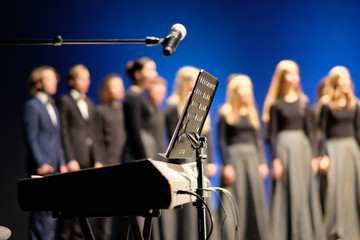
Jazz singing is a much different form of expression, focusing on rhythm and interesting and unconventional harmonies. Lots of jazz songs contain intricate rhythms, using the swing style and staccato (short and disconnected) eighth notes to create crisp and groovy phrases (yes, I said groovy, cause it is. You groove). Jazz uses a more bright and conversational tone. This tone is obtained by narrowing the vowels slightly, and singing like you speak to a certain degree. While you should still keep a straight back for air flow, jazz is less restrictive in posture; feel free to move to the music! Tap your foot, sway side to side, move your arms, do whatever you see fit to lose yourself in the music. Another unique element of the jazz style is improvisation. In jazz charts, there will be sections where the choir cuts out, the instrumentals will play, and a single singer or small group will improvise. That’s right. They make up their singing on the spot. This is accomplished by using a variety of rhythms, “scat” syllables (such as bop, ba, doo, daht, etc), and singing notes that fit within the chord structure and key signature. This is a very brief explanation of improv, or “scatting,” so remember it’s a tough and complex skill to master. Overall, jazz is a unique and different art form. It utilizes rhythm, unique sound, and creativity. A great example of a swing tune with complex rhythms and chords with an improvisation section is Mr. Hooper’s Find It In a Minute Book – https://youtu.be/zQaaVpAzpwM
An Introduction to “And On That Note” with Ethan Schopp
Welcome to And On That Note. My name is Ethan Schopp, and let me tell ya, I am very excited to be doing this blog. If you can’t tell from the title and imagery, this is a blog about music. “Another one of those?” you’re probably thinking. Yes, it is, but this blog is about more than just music. It’s about the experiences that come with music, the concerts, the events, the love, the passion, the heart and soul of making music with other human beings. Here, we’ll talk about choral music, vocal jazz, some of my favorite songs both choral and contemporary, my personal music experiences, and more. My goal is to be a window into the world of music for people that may not necessarily know to much about it. After all, I am making music education my career. So for now, stay tuned to learn more about the beauty and heart of music. To get you started, here’s a link to a YouTube playlist of my favorite choir songs. Enjoy, and happy listening!
Ethan Schopp – Beautiful Choir Music

 And On That Note