

Music is an art form with countless genres and styles. In my experience with high school choir, there are two main styles that rule supreme in choral singing: Classical and Jazz. Each style requires a certain vowel shape, tone quality, facial expression, and so on. This is not to say either style is better than the other. Each style is unique in its own way, so lets take a look at how each expresses itself.
Classical singing focuses on beauty and expression through thick chords and flowing, connected phrases. The texts of classical pieces can be a number of languages with Latin and German being among the most common. A large variety of classical music also contains religious texts and ideas, as a lot of classical composers, like Mozart or Palestrina, had influences from the church. The classical style uses a much darker and smoother vocal tone. This doesn’t mean the music itself is darker or sadder, but it means that the voice is fuller in nature, and the vowels used are very tall and thick in texture. For example, when singing the word “God” in the classical style, it would not be pronounced like we speak it, “Gahd,” rather we would use a tall “o” vowel to form a sound like, “Gawd.” When performing in the classical style, it’s important to keep good posture. Keep your hands at your sides, stand up straight to allow air flow, and don’t lock your knees. Overall, classical singing is unique in that it uses flowing phrases, smooth and thick tones and chord structures, and dynamic/stylistic expression to paint a picture of the text being sung. I’ll include a link to one of the songs in my “Beautiful Choir Music” playlist that is a prime example of the classical style: Sicut Cervus by Palestrina – https://youtu.be/AAgd6jBTMek
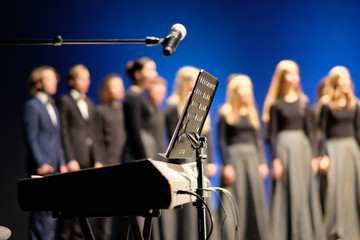
Jazz singing is a much different form of expression, focusing on rhythm and interesting and unconventional harmonies. Lots of jazz songs contain intricate rhythms, using the swing style and staccato (short and disconnected) eighth notes to create crisp and groovy phrases (yes, I said groovy, cause it is. You groove). Jazz uses a more bright and conversational tone. This tone is obtained by narrowing the vowels slightly, and singing like you speak to a certain degree. While you should still keep a straight back for air flow, jazz is less restrictive in posture; feel free to move to the music! Tap your foot, sway side to side, move your arms, do whatever you see fit to lose yourself in the music. Another unique element of the jazz style is improvisation. In jazz charts, there will be sections where the choir cuts out, the instrumentals will play, and a single singer or small group will improvise. That’s right. They make up their singing on the spot. This is accomplished by using a variety of rhythms, “scat” syllables (such as bop, ba, doo, daht, etc), and singing notes that fit within the chord structure and key signature. This is a very brief explanation of improv, or “scatting,” so remember it’s a tough and complex skill to master. Overall, jazz is a unique and different art form. It utilizes rhythm, unique sound, and creativity. A great example of a swing tune with complex rhythms and chords with an improvisation section is Mr. Hooper’s Find It In a Minute Book – https://youtu.be/zQaaVpAzpwM
 And On That Note
Why can’t we learn this in chorus?
LikeLike
Beats me, man. I really wish that this was part of the curriculum.
LikeLike